 Learn and Play
How to Teach Shapes to Preschoolers Through Play
Published By Learn and Play
A circle on a worksheet can feel abstract. A round plate, a square box and a rectangular book are much easier for a child to notice, touch and compare.
That is why learning shapes works well as part of everyday play. You can start with a few simple shapes, look for them around the home, sort them, turn them around, compare their sizes and eventually talk about features such as sides and corners.
The aim is not to make a preschooler memorize a long list of shape names. It is to help the child notice what makes one shape different from another.
Start with a few simple shapes
Begin with shapes that are easy to distinguish from each other, such as a circle, square and triangle.
Use objects the child can hold or point to. You can cut simple shapes from paper, use wooden blocks, draw them on cards or find them in toys you already have.
Show one shape at a time and use its name naturally:
- “This is a circle.”
- “Can you find another circle?”
- “Which one is the triangle?”
- “Can you put the two squares together?”
At this stage, recognition is more useful than asking the child to explain a formal definition.
The Match the Shape activity gives younger children a similar type of practice: they look at one shape and find the matching shape among the choices.
Connect the name with the shape
A child may recognize that two objects look alike before consistently remembering the word “triangle” or “rectangle.”
You can practice the words without turning the activity into a quiz.
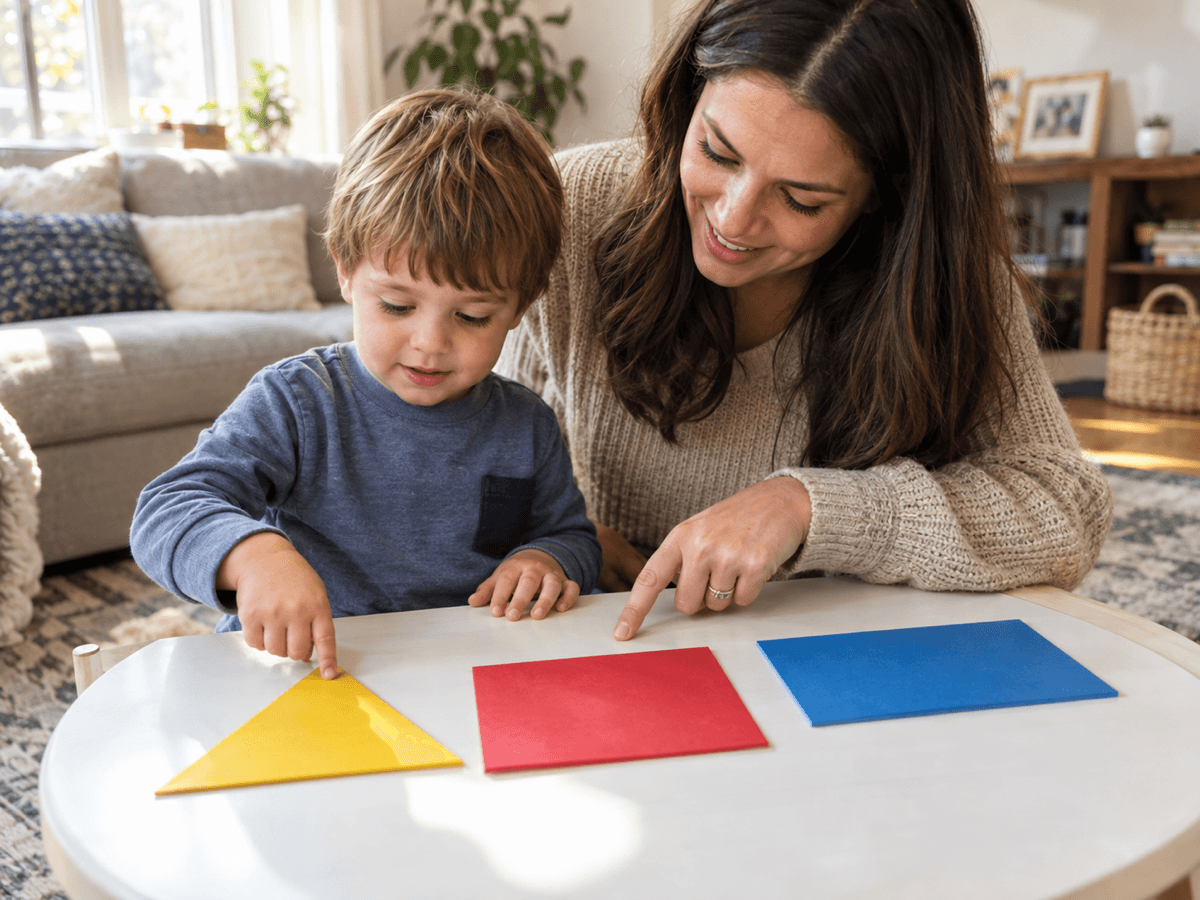
Place three shapes on the table and say, “Can you give me the square?” Later, reverse the task: point to a shape and ask, “What do we call this one?”
The Find the Named Shape game combines the same two ideas by letting the child hear a shape name and then find the matching shape.
If the child forgets a name, simply say it again and continue. Repetition can happen naturally across many short activities.
Look for shapes in everyday objects
Once a child recognizes a few basic shapes, start looking for them outside the set of shape cards.
A plate can look like a circle. A book cover may be a rectangle. A square storage box can become a quick shape example. A window, clock, tile or picture frame can all become part of the game.
Try questions such as:
- “Can you find something round in this room?”
- “Which object looks like a rectangle?”
- “Can you find two things that have the same shape?”
- “Is this plate more like a circle or a square?”
This is useful because the same shape does not always appear as a brightly colored classroom symbol.
Learn and Play includes Find Shapes in Everyday Objects, where children connect a simple shape with familiar real-world objects that have a similar outline.

Help the child look past color
Color can make shape matching easier, but it can also become a distraction.
If every triangle is yellow and every circle is blue, a child can sometimes solve a task by color instead of really looking at the outline.
Try using:
- several circles in different colors;
- the same triangle in red, blue and green;
- a large square and a small square;
- matching shapes mixed with unrelated colors.
Ask, “Are these still both circles even though they are different colors?”
The Find the Same Shape in Different Colors activity directly practices this idea, while Find the Same Shape in Different Sizes asks children to recognize a shape even when its size changes.
The important idea is simple: color and size can change while the basic shape remains recognizable.
Sort shapes into groups
Sorting gives a child a reason to compare several shapes instead of looking at only one.
Put a mixed pile of paper or toy shapes on the table and make one place for circles, one for squares and one for triangles.
You can start by sorting together. Later, let the child decide where each piece belongs.
To make it slightly harder:
- use more shapes;
- mix different colors;
- mix different sizes;
- ask the child to explain why two pieces belong together.
The Learn and Play Sort Shapes into Boxes game turns this into a drag-and-drop activity. The 4–5 version adds more items and makes color less useful as a clue, so the child has to pay closer attention to the shape itself.
Turn and move the shapes
Children often first see shapes in one familiar position: a triangle pointing up or a square sitting flat.
But the same shape can look different when it is turned.
Take a paper triangle and rotate it. Ask, “Is it still a triangle?” Turn a square so that it looks like a diamond and compare it with the original position.
Do not worry about introducing technical vocabulary. The useful part is simply noticing that turning a shape does not automatically make it a new shape.
For children who are ready for a more detailed visual task, Find the Shape Even When It Is Turned adds practice with shape orientation.
Use shape puzzles and fitting games
Puzzles give shape recognition a physical purpose: a piece either fits the space or it does not.
At home, you can use a simple shape sorter, inset puzzle or homemade cardboard board with a few large cut-out outlines.
Ask the child to look at the outline before trying a piece:
- “Which hole looks like this shape?”
- “Should we turn it?”
- “Does this one have the same outline?”
The Put Shapes in Their Holes activity uses the same idea in an interactive format, while Complete the Simple Shape Puzzle adds simple part-to-whole matching.
For ages 4–5: look at sides and corners
Once a child comfortably recognizes basic shapes, you can start talking about what they notice around the outline.
Use a large paper triangle, square and rectangle. Trace each edge with a finger and count the sides together. Then touch each corner one at a time.
For example:
- a triangle has three sides;
- a square has four sides;
- a rectangle also has four sides.
You do not need to turn this into a formal geometry lesson. The point is to help the child look more carefully at the features of each shape.
Learn and Play has separate Count the Sides and Count the Corners activities, where children tap each feature one at a time while counting.
Connect flat shapes with real objects
For older preschoolers, you can also compare a simple flat shape with objects that have a related form.
A drawn circle and a ball are not the same thing: one is a flat shape and the other is a three-dimensional object. But comparing them can help a child pay attention to visual form.
Try putting a few objects on the table and asking which one best matches a circle, rectangle or another shown shape.
The Match the 2D Shape to the 3D Object activity gives children this kind of visual comparison.
Keep the language simple. There is no need to introduce every formal 3D-shape term at once.
Shape ideas for ages 2–3
For younger preschoolers, keep the task concrete and the number of choices small.
Useful activities include:
- matching two identical shapes;
- hearing a shape name and finding it;
- putting shapes into matching holes;
- sorting a few shapes into groups;
- finding the same shape in different colors;
- noticing circles, squares and triangles in familiar objects.
A short activity with two or three shapes is enough. You can always repeat it later with different objects.
Shape ideas for ages 4–5
For older preschoolers, make the visual differences less obvious.
Try:
- using more shape choices at once;
- mixing colors so color cannot solve the task;
- turning shapes into different orientations;
- comparing sides and corners;
- finding several examples of the same shape in one room;
- sorting shapes by outline instead of color;
- connecting flat shapes with familiar objects.
The child does not need to complete all of these skills in one session. Choose one idea and keep the activity short.
A simple 10-minute shape routine
You can build a quick shape activity from things already at home.
2 minutes: choose three basic shapes and name them together.
2 minutes: find one household object that resembles each shape.
2 minutes: sort a few paper or toy shapes.
2 minutes: turn or resize the shapes and ask whether they are still the same shape.
2 minutes: finish with one relevant Learn and Play shape activity.
Change the order or skip steps whenever the child loses interest. The routine is only a simple way to vary the type of practice.
The main idea: shapes are everywhere
Learning shapes becomes more meaningful when circles, squares and triangles are not limited to flashcards.
Look at plates, windows, books, boxes and toys. Match them, sort them, turn them and compare them. As the child becomes more confident, begin noticing details such as sides and corners.
For more practice, explore the Shapes & Colors activities on Learn and Play for ages 2–3 or ages 4–5 and choose a short game that matches the kind of shape practice you have just done together.