 Learn and Play
How to Teach a Child to Count to 10 Through Play
Published By Learn and Play
A child can learn the words “one, two, three…” before fully understanding what those words mean. Real counting develops when the child starts connecting each number word with one object, understands how many objects are in a group, and begins to recognize the written numerals that represent those quantities.
You do not need worksheets or long lessons to practice this. Toys, fruit, stairs, blocks and a few short interactive games are enough to turn counting into something a child can see and do.
The goal is not to make a preschooler recite numbers as quickly as possible. It is to help numbers make sense.
What does “counting to 10” actually involve?
Several small skills work together when a child counts a group correctly.
First, the number words need to come in the right order: one, two, three, four and so on. Then the child needs to match one number word to one object instead of counting the same object twice or skipping one. Finally, the last number said needs to answer the question “How many are there?”
Written numerals add another layer. A child may know that a group contains five apples but still need practice recognizing the symbol 5.
That is why it helps to vary counting activities instead of repeating only the number sequence from 1 to 10.
1. Start with objects the child can touch and move
Physical objects make counting concrete.
Put three toy cars on the floor and ask, “How many cars are here?” Let the child touch or move each one while counting. At snack time, count blueberries, crackers or apple slices. On the stairs, say one number for each step.
The movement matters because it makes it easier to keep track of which objects have already been counted.
A similar idea is used in Learn and Play's Count the Apples activity. The child taps the apples one by one while counting them, which encourages careful one-to-one counting rather than guessing from the picture.
Do not worry if the child needs to start with only two, three or four objects. A smaller group that the child can count accurately is more useful than rushing toward ten.
2. Make one number word match one object
A common counting mistake is saying numbers correctly while pointing too quickly, skipping an object or counting one twice.
You can make this easier by giving every object an action.
For example:
- move one block into a box for each number;
- put one spoon beside each plate;
- give one toy animal one pretend piece of food;
- place one sock into a laundry basket at a time.
The Feed the Rabbit counting game uses the same principle: each carrot is moved individually. The child is not only saying a number sequence but pairing each counted item with a separate action.
If the child loses track, slow down. There is no need to start the entire activity again every time.
3. Connect spoken numbers, quantities and written numerals
Knowing the word “four,” seeing four objects and recognizing the numeral 4 are related skills, but they are not exactly the same task.
Try simple combinations at home. Show a card with the number 3 and ask the child to place three blocks beside it. Or make two small groups of toys and ask which group has the amount you name.
Interactive activities can change the direction of the challenge.
In Pick the Apple Group, the child hears a number and chooses the group with that quantity. In Find the Number, the child hears a number and looks for the matching written numeral.
Alternating between these types of tasks helps prevent counting from becoming only a memorized chant.
4. Use counting during normal routines
Counting practice does not need its own scheduled lesson.
Look for situations where numbers already have a purpose:
- “Can you put four forks on the table?”
- “We need three blocks for this tower.”
- “How many steps are left?”
- “Can you bring me two socks?”
- “There are five strawberries. What happens if we eat one?”
These small questions show that numbers describe real quantities.
Keep the conversation casual. If every moment turns into a test, a useful everyday activity can quickly stop feeling like play.
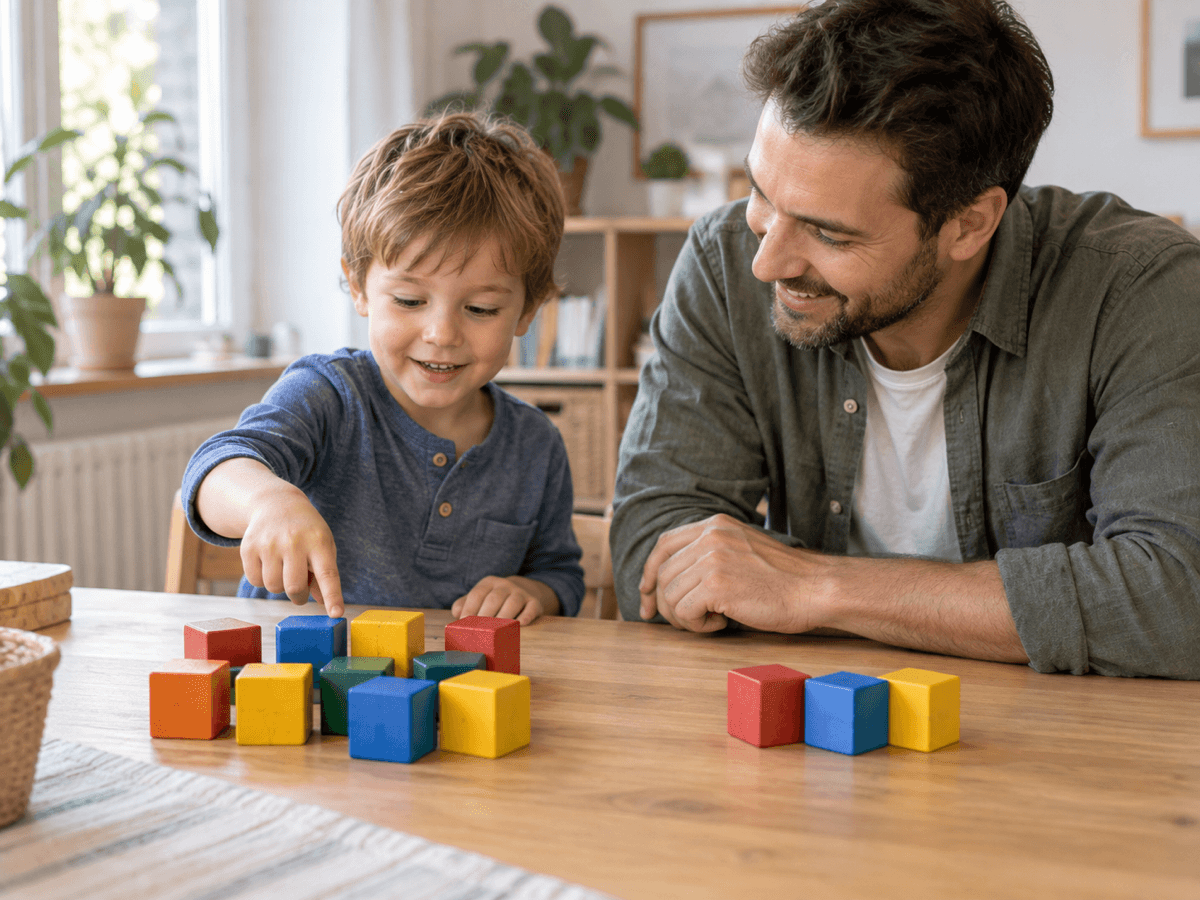
5. Compare groups before introducing arithmetic symbols
Before formal addition and subtraction, children can explore useful mathematical ideas by comparing groups.
Put two groups of objects next to each other and ask:
- Which group has more?
- Which has fewer?
- Do they have the same amount?
- How could we make them equal?
For younger children, Which Domino Has the Most Dots? turns this into a visual counting challenge.
For ages 4–5, More, Fewer, or the Same? asks the child to compare two groups and identify the relationship between their quantities.
These questions make counting useful: the child is counting in order to decide something.
6. Practice what comes before and after a number
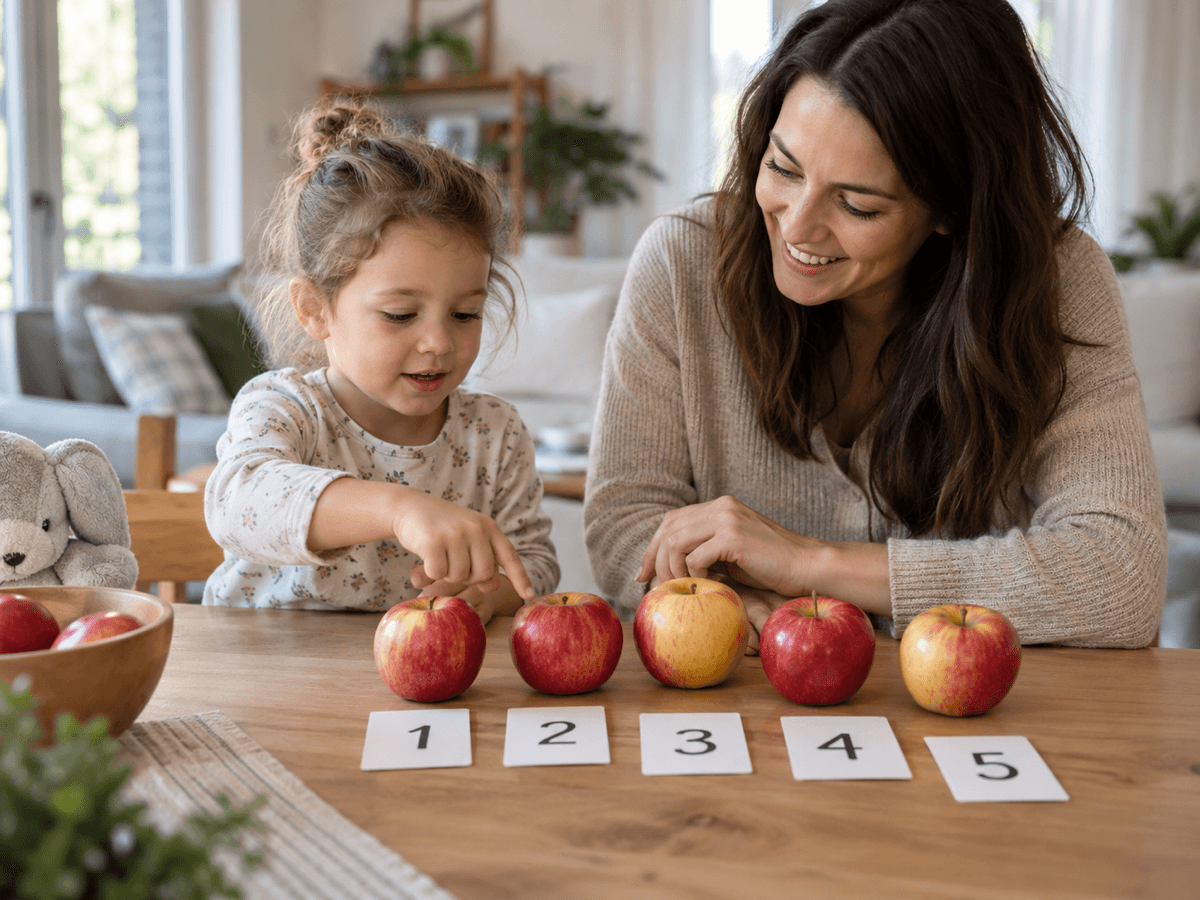
Once a child is comfortable counting groups, work with the order of numbers.
You can line up number cards and remove one. Ask which number is missing. Start counting at 4 instead of always beginning at 1. Ask, “What comes after 6?” or “What number is just before 9?”
The Learn and Play Order the Train Cars activity gives children numbers to place in sequence, while Missing Number asks them to complete a short number sequence.
For another step, Which Number Is One More? connects a visible quantity with the next number.
The important part is that the child begins to see numbers as related to each other, not as ten unrelated symbols.
7. What to do when the child gets stuck
Getting a wrong answer does not necessarily mean the child does not understand counting. Sometimes the group is too large, the objects are too close together, or the child simply loses track.
Try one change at a time:
- reduce the number of objects;
- spread the objects farther apart;
- let the child move each item after counting it;
- count together for the first few objects;
- return to a number range the child handles confidently;
- stop while the activity is still enjoyable and try again later.
If the child says “one, two, three, five,” repeat the sequence naturally and count together rather than turning the mistake into a long correction.
Short, repeatable practice is usually easier to fit into family life than one long “math session.”
Counting ideas for ages 2–3
For younger preschoolers, keep the task visible and concrete.
Good starting activities include:
- counting small groups of familiar objects;
- touching or moving each object while counting;
- hearing a number and finding a matching small group;
- recognizing a few familiar numerals;
- comparing two clearly different quantities.
Learn and Play includes separate Math & Numbers activities for ages 2–3, so the child can practice the same general idea in different ways rather than repeating one screen over and over.
Counting ideas for ages 4–5
Older preschoolers can often handle more variation.
Try:
- counting groups up to 10;
- finding a numeral among several choices;
- comparing quantities that are close to each other;
- putting numbers into order;
- finding a missing number in a sequence;
- identifying one more or one less;
- combining or taking away small groups using visible objects.
The key is still understanding, not speed. If a child can explain or show why an answer is correct, that is more useful than racing through ten questions.
A simple 10-minute counting routine
You can combine everyday play and an online activity without making either one feel like homework.
2 minutes: count something real — blocks, fruit, cars or steps.
2 minutes: ask the child to make a group of a number you choose.
2 minutes: show or find written numerals.
3 minutes: play one relevant Learn and Play activity.
1 minute: finish with an easy question the child can answer confidently.
There is no need to complete all five steps every day. The routine is simply a way to vary the skill being practiced.
The main idea: help numbers mean something
Learning to count to 10 is not just learning a line of words. Children gradually connect number words, individual objects, total quantities and written numerals.
The easiest way to support that process is to use numbers in situations where they have a real purpose: setting the table, sharing snacks, building with blocks, climbing stairs and playing short counting games.
When the child is ready to practice on screen, explore the Math & Numbers activities on Learn and Play for ages 2–3 or ages 4–5 and choose a task that matches what you have just practiced together.